
What You Will Learn in This Article:
-
What is Grating? Definition and Main Components
-
Grating Manufacturing Processes
Get to Know Grating
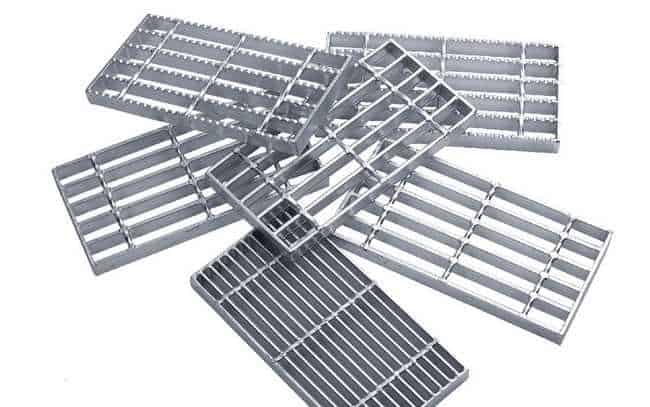
Grating (mesh panels) can be defined as a structure consisting of a series of similar metal bars placed parallel to each other at equal intervals. These bars are connected together by cross bars in a perpendicular arrangement, forming a rectangular grid structure.
Grating panels are commonly manufactured from materials such as carbon steel, 6000 series aluminum alloys, and 300 series stainless steel. However, grating can also be produced using other alloys and materials depending on the required application and environmental conditions.
Grating (mesh panels), which are manufactured using flat bars and round bars, are classified into different types based on their manufacturing details and industrial applications, including metal grating, aluminum grating, stainless steel grating, fiberglass (FRP) grating, bar-to-bar grating, and bar-to-half-bar grating.
Main Components of Grating:
-
Bearing Bars
-
Cross Bars
Bearing Bar
The bars that are positioned vertically in the grating structure are called bearing bars.
For light-duty applications, these bars are commonly available in dimensions of 3/4″ × 1/8″, while for heavy-duty applications, larger sizes such as 7″ × 1/2″ are used. The spacing between bearing bars is specified in sixteenth-inch increments and generally ranges from 19/16″ to 7/16″.
Standard gratings are also available with wider bearing bar spacing, which provides a larger open area. However, these dimensions should not be selected without consulting the grating manufacturer, as they must be determined based on load requirements and application conditions.
Heavy-duty gratings are products in which the bearing bars are typically manufactured with dimensions of 3/8″ × 15/16″ and are spaced on centers according to the required load capacity.
Cross Bar
Cross bars are used to secure and maintain the position of the bearing bars within the grating structure.
The dimensions and specifications of cross bars vary depending on the manufacturing method and the selected material. Similar to bearing bars, cross bar spacing is measured from center to center. The standard center-to-center spacing is typically 4 inches, while 2-inch spacing is also available for special orders and applications.
Grating Manufacturing Methods
Welded Grating
In this manufacturing method, bearing bars and cross bars intersect each other in a perpendicular arrangement and are permanently joined through welding. This process is typically performed using automatic forge welding equipment. The resulting welded connections provide high reliability and strength, making this type of grating ideal for industrial applications.
Pressure Locked Grating
In this method, cross bars are inserted into pre-punched openings in the bearing bars, and hydraulic pressure is applied to lock the bars firmly into position. This manufacturing method is highly effective for producing aluminum grating, stainless steel grating, and gratings with close mesh spacing.
Dovetail Pressure Locked Grating
In the dovetail pressure locked method, punched bearing bars and cross bars are assembled together to form a structure similar to a dovetail or honeycomb pattern. The bars are then mechanically locked through deformation. This manufacturing method is suitable for producing gratings with excellent geometric accuracy and high-quality appearance.
Riveted Grating
In riveted grating, bearing bars are permanently fastened to serrated cross bars using rivets, creating one of the strongest and most durable grating structures. This type of construction is highly suitable for applications where the grating is exposed to shock loads and sudden impacts caused by the movement of heavy vehicles or material-handling equipme