
Grating Clamps and Their Key Role in Grating Installation Connections
Introduction
To install grating securely, ensure its stability, and prevent accidents caused by the grating moving on the platform surface, appropriate safety measures must be considered. The grating must be firmly secured to its supporting structure. Depending on the grating material and the type of supporting surface, different methods may be used to prevent movement.
Most steel gratings have a galvanized coating, while platforms and channels are usually made of steel. Therefore, welding the grating directly to the supporting structure may initially appear to be a suitable method. However, this method eliminates the possibility of moving or removing the grating panels and restricts access to the inside of the channel.
Furthermore, high-quality welding cannot normally be performed directly on galvanized components. Welding also damages the platform’s paint coating and the galvanized coating of the grating.
For this reason, welding is recommended only when the use of grating clamps is not possible. When welding is necessary, several important points must be considered.
First, the welding points should be selected so that the grating can be separated again when necessary. The welds should be positioned in such a way that the grating can later be removed by grinding the welds or using a suitable lever.
Second, to ensure adequate weld strength, the paint and galvanized coating must be removed from the welding area before welding. This allows the weld to achieve the required strength and structural integrity.
Finally, the welded areas and their surroundings must be coated with zinc spray. This is necessary both to improve the appearance and to prevent corrosion from developing around the damaged coating.
For installing galvanized or fiberglass grating in certain channels or walkways, the grating support can be designed so that the grating is placed in position by gravity and has no space for lateral movement.
Although this installation method is simple, it has a relatively low safety factor. Unexpected lateral or vertical forces may cause the grating to move out of position.
Because the grating edges usually support both the applied loads and the grating’s own weight, even very small displacements can be dangerous and may cause the grating to fall from its supporting seat.
This method is commonly used for concrete channels because welding or the direct use of conventional grating clamps may not be possible. For greater stability, it is recommended that adjacent grating panels be connected to one another using grating clamps or welding. This reduces longitudinal movement.
The clearance between the grating and its seating area must also be kept as small as possible so that lateral movement is minimized.
In this installation method, the grating thickness and the depth of the grating seating area are important factors. The upper surface of the grating must remain lower than the adjacent surfaces and surrounding edges.
The grating thickness should also be at least 30 millimeters, because gratings with a smaller depth can be displaced from their installation position more easily.
It should also be noted that the grating may gradually become warped over time. Such deformation can reduce its stability. Therefore, observing the above requirements is essential for efficient and long-term use of the grating.
In some cases, channels are constructed without considering how they will later be covered. In such situations, an oversized grating panel may be placed directly over the channel.
The first disadvantage of this installation method is that the grating surface remains higher than the surrounding surfaces. The grating may be secured to the ground using grating clamps, bolts, and wall plugs.
However, because the sides of the grating remain exposed to impact, the bolts and wall plugs may become damaged relatively quickly and lose their effectiveness. The strength of the supporting surface and the type and quality of the concrete also have a major influence on the reliability of this installation method.
To overcome these problems, gratings with angle sections welded around their edges may be used. With this type of grating, the height difference between the grating and the surrounding surfaces is reduced to approximately the thickness of the angle-section flange.
This design also prevents lateral movement and protects the grating against side impacts. In this case, connecting adjacent grating panels by welding or using grating clamps is also recommended.
Grating is primarily used to create a strong and stable flooring surface. Columns support the main beams, and the main beams support the secondary beams. The entire surface is then covered with grating.
Large offshore oil platforms, refinery and petrochemical structures, and access walkways leading to the upper sections of tanks and towers are all constructed using grating.
More than 95 percent of gratings are installed on steel structures. Coding and marking the grating panels are essential for positioning each panel accurately.
During installation, the orientation of the bearing bars between the beams must be observed. The grating edges are generally placed on the supporting beams. If lateral movement occurs, there is a risk that both the grating and the people walking on it may fall.
One of the main advantages of grating is the speed and simplicity of its fabrication and installation. For this reason, grating panels must be manufactured according to appropriate principles and standards.
The panels should not be excessively large. Panels larger than approximately 1.5 square meters may create difficulties during fabrication, galvanizing, transportation, and installation.
The dimensions of a grating panel should allow it to be moved manually. It should also be designed and transported in a way that prevents deformation during galvanizing and handling.
Ensuring that the grating remains flat is extremely important. An uneven or warped grating surface can create serious problems when grating clamps are used.
Grating Clamps and Their Advantages
Although welding can be used in many cases to install grating on a steel structure, grating clamps are generally preferred for a proper and technically reliable installation.
One of the main advantages of using grating clamps instead of welding is that they do not damage the paint coating or galvanized coating of the structure and the grating.
Another important advantage is that grating clamps allow the grating panels to be removed or repositioned when necessary.
Regardless of whether the supporting structural profile is an I-beam or a channel section, the flange of the profile is normally in contact with the grating.
Therefore, the grating clamp only needs to create a strong connection between the grating and the flange of the supporting beam.
The grid-like structure of the grating makes it possible to install clamps at suitable points around the panel. However, the clamps must normally be installed on the bearing-bar side.
An exception may apply to press-locked grating or bar-in-bar grating with a square mesh, where both directions may have similar structural characteristics.
Each grating panel must be secured to the structure using at least four complete sets of grating clamps.
For larger grating panels, the spacing between grating clamps should not exceed approximately 70 centimeters.
Types of Grating Clamps
Grating clamps are available in several different forms.
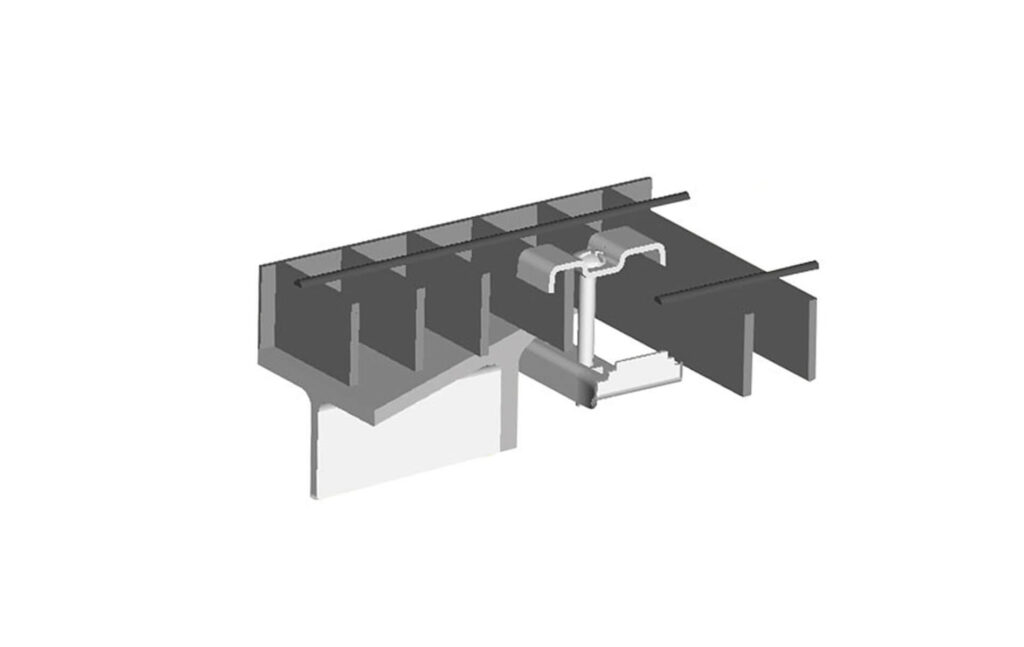
The most common type consists of a bolt and nut of a suitable length, washers, a lower hook component, and an upper saddle component.
Upper Saddle Component
The upper component of the grating clamp is positioned over two bearing bars. A hole corresponding to the bolt size is provided in the center of this component.
Its shape resembles an eyebrow, with two convex curves on the sides and a concave curve in the center.
The center-to-center distance between the two convex side curves corresponds to the center-to-center spacing of the grating’s bearing bars.
The central concave section must be deep enough to prevent the bolt head from extending above the grating surface. At the same time, it must not interfere with the use of a wrench.
The upper saddle is generally designed so that it can be used with a range of gratings having different mesh sizes.
Its width is normally between 25 and 30 millimeters, while its length ranges from approximately 40 to 60 millimeters.
When an M8 bolt is used, a hole with a diameter of approximately 10 millimeters is provided in the center of the upper saddle.
The thickness of this component normally ranges from 2.5 to 4 millimeters, with 3 millimeters being the most commonly used thickness.
Like the grating itself, the upper saddle is normally hot-dip galvanized, often using a centrifuging process suitable for small components.
Lower Hook Component
The lower part of the grating clamp is known as the hook component, a name derived from its physical shape.
The hook component has a carefully designed structure. One of its important characteristics is its strength, which results from its thickness, bends, and overall geometry.
The hook is positioned below the grating, and the width of its head is secured between two bearing bars.
Two or three stepped sections may be formed at the hook head. These steps allow the same hook to be used with gratings having different or closely spaced mesh dimensions.
The stepped section and the head of the hook are bent upward so that they can be secured easily between the bearing bars.
Because this section requires high strength, reinforcing ribs must be considered in the forming die during the bending process.
An elongated slotted hole is provided in the hook component to allow the bolt to pass through it. This elongated hole makes it possible to adjust the hook and position it at the most suitable location.
However, the elongated hole reduces the strength of the component in that area.
This weakness is compensated for by bending the sides of the hook. These side bends provide adequate structural strength and simultaneously act as a built-in wrench that holds the nut in place.
Because access to the underside of the grating is normally not possible during installation, this feature is particularly useful.
When the hook acts as a built-in wrench, the opening dimensions, the contact between the nut and the wrench surfaces, and the rigidity of the wrench opening are all critical factors.
These design considerations have been observed in the grating clamp hooks manufactured by Dezh Ahan Parseh Industries (صنایع دژآهن پارسه).
The end of the hook component is positioned under the flange of the supporting beam. This is the main point at which the grating clamp connects to the structure.
As the bolt is tightened, greater pressure is created between the upper saddle and the lower hook. Consequently, the grating panel and the beam flange are compressed together.
The bending geometry, cuts, dimensions, and thickness of the hook component must therefore be carefully calculated to provide the required stability.
The normal and commonly used length of the lower hook is approximately 11 centimeters.
It is generally manufactured from steel sheet with a thickness of approximately 2 to 3 millimeters, and its slotted hole is designed for an M8 bolt.
The hook is normally protected with a hot-dip galvanized coating.
The upper saddle and lower hook are connected using a bolt, nut, and washers.
An M8 bolt and nut with property class 8.8 are considered suitable for this application. The bolt grade is important because the bolt is a load-retaining component and remains under continuous pressure.
The nut must fit precisely inside the built-in wrench section of the hook. The bolt may have either a hexagonal head or a hex-socket head.
The use of both flat and spring washers is necessary during tightening.
The bolt length depends on the grating depth and the thickness of the beam flange. Bolts with lengths between approximately 7 and 9 centimeters are used most frequently.
Like the grating clamp itself, the bolt and nut coating must resist corrosion.
However, because the quality of hot-dip galvanizing on threaded fasteners may be inadequate and the nut threads may need to be oversized, a Dacromet coating is often used for bolts and nuts.
Important Considerations for Installing Grating with Grating Clamps
Several key technical points must be considered when grating is connected to a structure using clamps.
Metal gratings, including hot-dip galvanized and stainless steel gratings, may develop slight but unavoidable deformation due to fabrication, welding, and galvanizing processes.
Packaging, loading, and transportation may also cause the grating to become warped.
If a deformed grating is installed and even a very small gap remains between the grating and the supporting structure, repeated pedestrian traffic and vertical movement may eventually cause the lower hook to move out of position.
This condition may lead to serious and potentially irreversible accidents.
Therefore, during installation, the installer must ensure that no gap exists between the grating and the supporting structure.
For this reason, the bolt strength and the structural integrity of the upper saddle and lower hook used in the grating clamps manufactured by Dezh Ahan Parseh Industries (صنایع دژآهن پارسه) are carefully evaluated.
Another important point is that the grating-clamp bolt must never be installed at an inclined angle.
The bolt must be positioned perpendicular to the grating surface, at a 90-degree angle.
When a clamp is tightened with the bolt at an incorrect angle, it may initially appear secure. However, weather changes, vibration, and long-term service may cause the clamp to move.
The installers of Dezh Ahan Parseh Industries (صنایع دژآهن پارسه) observe the relevant technical and safety requirements and implement the grating installation standards carefully.
When designing and manufacturing grating clamps, attention must be paid not only to strength but also to an important practical limitation.
Once the grating panel has been placed in its final position, access to the underside of the grating is no longer available for installing the clamp.
This limitation directly affects the design of the lower hook.
The hook must be small enough to pass through one of the grating openings.
The bolt length must also be selected so that the hook can pass through the grating opening while the nut remains attached to the bolt.
On the other hand, improving the strength and functionality of the lower hook generally requires larger and longer components.
By considering all of these requirements, Dezh Ahan Parseh Industries (صنایع دژآهن پارسه) has designed and manufactured grating clamps suitable for different types and dimensions of grating.
In these designs, attention has been given to quality, functionality, and production capacity.
Unfortunately, the use of numerous non-standard grating sizes and mesh arrangements—which may initially appear to provide more options—can create serious installation problems when the fastening method has not been considered.
Different types of grating are currently supplied in the market without sufficient consideration of how they will be installed.
As a result, users may become confused during installation and may be forced to use technically unsuitable methods such as welding.
In other cases, they may use available grating clamps that are not compatible with the grating, resulting in an unsafe installation.
For additional information and answers to your questions, please visit the Contact Us page.