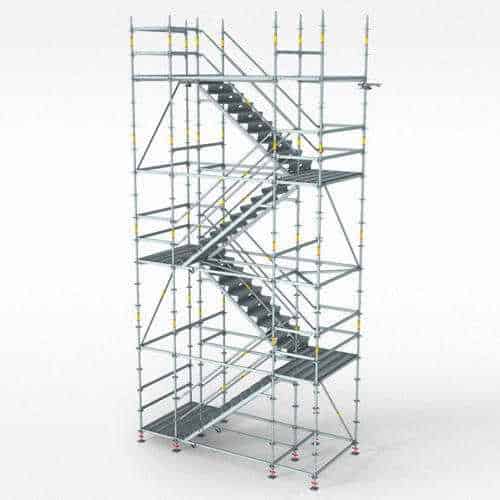
A stairway or staircase is the most common method for connecting levels with different elevations. In residential, commercial, and office buildings, stairways are usually constructed using materials such as steel, stone, and concrete. However, in industrial facilities, refineries, petrochemical plants, and power plants, stairways are commonly constructed using grating stair treads.
The manufacturing and installation of stair treads and landing platforms using grating are fast, efficient, and practical. However, it is essential to follow the technical and safety requirements during the design and construction of grating stairways.
The bearing bars in the grating stair treads manufactured by Dezh Ahan Parseh Industries are generally positioned along the length of the tread to ensure maximum load-bearing performance. The grating stair treads are usually connected to the stair stringers using perforated side plates, bolts, and nuts. For easier installation, one of the mounting holes is designed as a slotted hole, allowing adjustment and compensation for drilling tolerances and thermal movement.
This plate is commonly known as the stair side plate. A thickness of 6 mm and a width of 70–80 mm are commonly used for a wide range of stair applications. Care should be taken that if the corner of the stair side plate extends beyond the stair stringer beam or channel, the protruding edge should be trimmed accordingly.
Due to frequent foot traffic, grating stair treads are subjected to considerable impact loads. Therefore, if an unsuitable grating is selected for the stair span, bending and deformation may occur at the edges of the tread over time.
Dezh Ahan Parseh Industries uses stronger edge reinforcement elements such as angle bars or reinforced flat bars to increase the strength and durability of stair tread edges.
The mesh-like structure of grating and the need to look through the steps while walking can sometimes create visual discomfort or an optical illusion. To overcome this issue, Dezh Ahan Parseh grating stair treads are equipped with serrated steel plates or usually yellow-colored fiberglass coverings on the front edge of the steps. These features improve step visibility, distinguish each tread clearly, and make movement safer and easier.
In some cases, the supporting structure is manufactured without pre-drilled holes and does not include provisions for bolted stair installation. In such situations, angle brackets can be welded on both sides, and the stair tread can be securely fixed on these angles using clamps or bolts and nuts.
Another installation method is using an angle frame and placing the grating stair tread inside it. In this method, it should be ensured that the thickness of the grating tread is smaller than the angle flange height so that the angle edge does not protrude above the grating surface.